The model can work while the product and the organization around it still fails.
A field guide for the leaders who have to build, buy, deploy, and stand behind AI in high-stakes organizations.
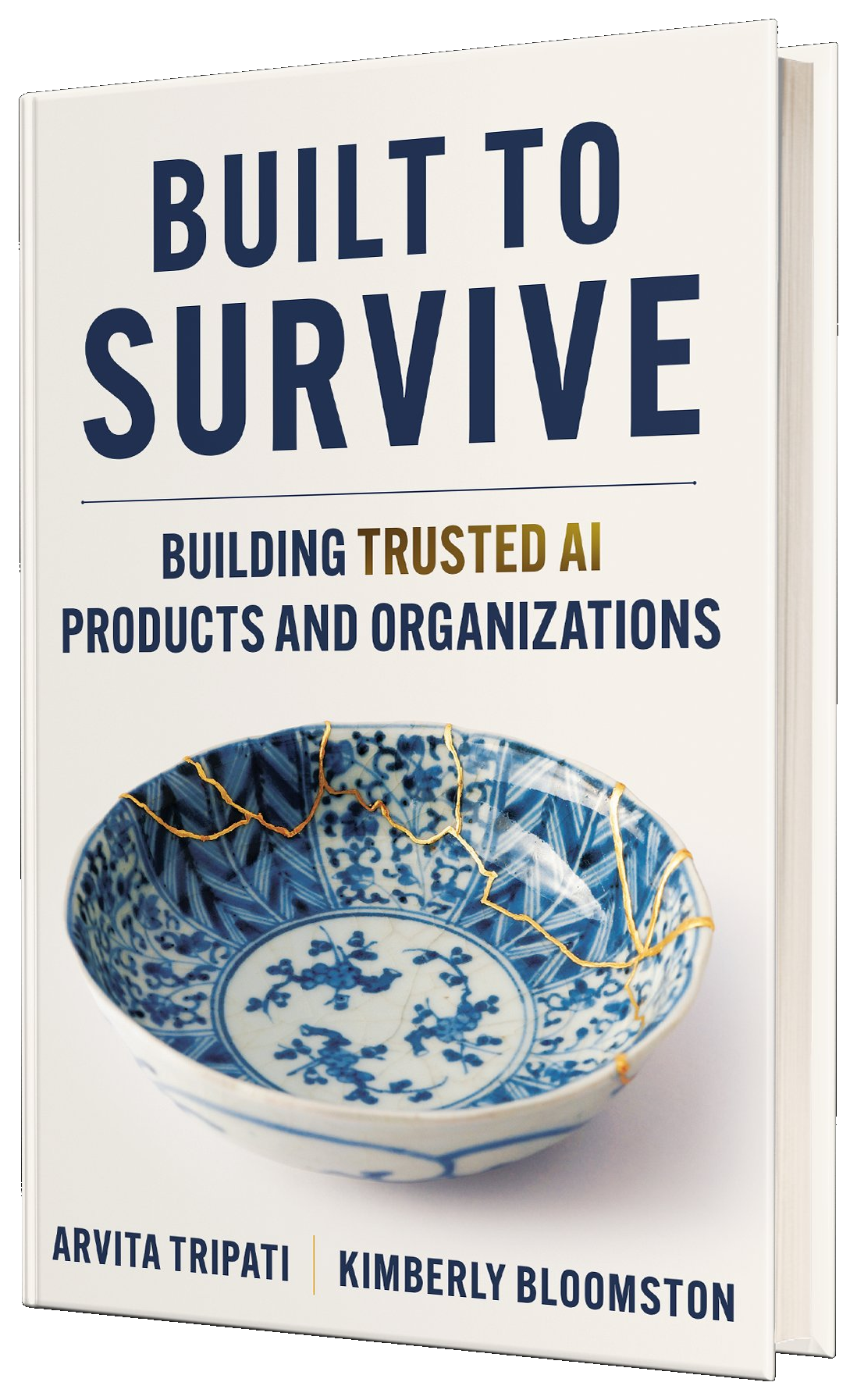
Built to Survive explains the organizational operating system required to make defensible decisions about claims, evidence, autonomy, oversight, economics, and accountability before the contract stalls, the deployment fails, or the risk reaches the board.
By Arvita Tripati and Kimberly Bloomston
Built for products where errors have real consequences
From first claim through deployment, monitoring, and renewal
Written from both sides of enterprise scrutiny
Decision tools, operating mechanisms, and prioritization guidance
Most AI failures begin as decisions no one owns.
Every one of these is a decision that was made by default. None of them is a modeling problem.
Each unresolved decision creates trust debt.
Trust debt is the accumulated gap between what an AI product or organization claims it can responsibly do and the evidence, controls, workflows, authority, and accountability required to stand behind it.
One place it becomes visible is the distance between a successful pilot and a defensible enterprise commitment.
Elsewhere it appears as a stalled contract, a deployment that never expands, a regulatory question the company cannot answer, or a business case that only works because humans continue doing the work AI was meant to remove.
Build the capabilities required for the decision, not every feature or artifact someone might request.
The answer is not more governance, more documentation, or a polished trust center disconnected from how the product actually operates.
It is the minimum credible infrastructure required by the product’s claims, autonomy, users, buyers, and consequences.
Build now
The evidence, controls, decision rights, and buyer-enablement mechanisms required for the next consequential decision.
Defer
Infrastructure that may become necessary later but does not yet solve a real product, buyer, operating, or risk problem.
Theater
Artifacts that create the appearance of responsibility without changing a decision, preventing a failure, or giving anyone meaningful authority.
What it takes for AI to survive contact with the enterprise
Claims the organization can defend
Translate ambitious product language into precise claims, evidence requirements, known limitations, and disclosure discipline.
Evidence matched to actual use
Determine what must be proven for the buyer, user, regulator, workflow, and consequence involved — not what is easiest to measure.
Decision rights that work under pressure
Clarify who decides, who advises, who can stop a release, and who accepts the remaining risk.
Human oversight that can actually intervene
Evaluate whether reviewers have the time, information, expertise, incentives, and authority required for meaningful oversight.
Economics that survive implementation
Account for integration, review, monitoring, support, remediation, and the work that does — or does not — disappear.
Buyer trust that continues after the contract
Build what adoption, expansion, monitoring, renewal, and a responsible response require when the product is wrong.
Trust debt compounds quietly. Then it becomes expensive.
It begins with reasonable shortcuts. Each one is taken in a different function, which is why no one sees the balance.
Individually, each shortcut looks manageable. Together, they create an organization that cannot explain, support, or economically operate the product it has built.
The book shows how to identify trust debt early, understand where it is accumulating, and pay down the liabilities that materially affect commercialization, adoption, safety, and enterprise value.
For the people accountable when “the model works” is no longer enough
CAIOs, CDAIOs, COOs, and legal, compliance, security, and risk leaders
Board members evaluating whether an organization can support its AI claims
Investors assessing whether AI capabilities can survive commercialization and scale
Written from both sides of enterprise scrutiny
A healthcare technology operator and advisor who has spent nearly two decades building and scaling regulated products across AI-enabled devices, diagnostics, clinical trials, connected health, and cell and gene therapy.
She has led product, engineering, regulatory, quality, privacy, security, and compliance functions — and has been both the vendor trying to pass enterprise scrutiny and the executive whose signature authorized the technology’s use.
She leads global product, design, and operations for an AI-powered revenue intelligence platform used by enterprise go-to-market organizations, with more than fifteen years scaling product in enterprise software, including product leadership at LiveRamp.
Together, the authors examine not only whether an AI system can perform, but whether the product, organization, commercial model, and operating infrastructure around it are capable of surviving real-world use.
For leaders responsible for consequential AI
We are inviting a limited group of executives, product leaders, enterprise buyers, investors, and educators to receive publication updates and advance materials.
Build AI that can survive the questions that come after the demo.
The hardest questions begin once the model performs.
Built to Survive is a practical guide to answering them before the debt comes due.